
Laser Level Calibration
You use a laser level, whether its indoors for fit out or outside for site levelling, is to make things level. If the laser level calibration is out then whatever you are trying to level will end up not being level. Even if you send your laser to get calibrated every six months you are not guaranteed that the laser level you are using is still in calibration. Under normal conditions laser levels do not generally go out of calibration on their own. Certainly a major drop or knock can cause problems, but also, excessive exposure to vibrations can also make a laser level go out of calibration. So what you want to do is regularly check your laser for calibration before any major job, but also on a regular basis. This is especially important if you are not the only user of the tool.So how can you check the calibration of your laser level?
First of all there are many types of laser level; rotating lasers, line lasers and dot lasers but the basic principle is pretty much the same for all when it comes to checking level. One popular method is to check you laser level against another laser or optical level. This is NOT the best way of doing it, mainly because you are making an assumption that the device you are checking against is perfectly calibrated. The best methods of checking calibration involves testing the laser against itself. The principle of checking a laser level against itself is pretty much the same as checking a spirit level. With a spirit level you place it on a surface and look at the position of the bubble. You then rotate the spirit level 180 degrees on the same surface and look at the bubble position again. If the bubble stays in the same position you know the level is true. If the bubble is in a different position then the level is no longer level.
So how do you apply this same principle to a laser level?
The first method I’m going to look at requires a reasonable sized room which is not brightly lit and has a solid floor. The larger the room and more dimly lit the more precisely you can check your laser level calibration. For this example I am going to assume you have a room approximately 10m square. This method works with rotating lasers with a visible beam, 360 line lasers and multiple 5 dot lasers.First
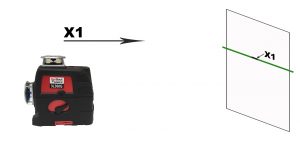
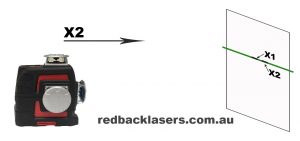
Place the laser level in the center of the room on a stable platform, ideally a tripod or solid surface. On some rotating lasers there may be arrows on the casing indicating the direction of the “X” and “Y” axis. If your laser does not have these markings pick a distinguishing feature of the laser. Such as the side the control panel is on or a handle. Direct your chosen side of the laser level at one of the walls. Power up the laser so it auto levels (for manual lasers manually level it up for each of the steps). Hopefully you can see the horizontal laser on that chosen wall. Attach a piece of paper on that wall and mark the height of the horizontal line, dot or rotating beam. Labeling it X1. NOTE: Its good practice when marking the position of a laser line/dot to always mark to the center of it and not one of the edges. Next rotate the body of the laser level 180 degrees (without changing the height of the tripod/surface) so the opposite side of the laser level body is now facing the wall with the piece of paper still attached. Power up the laser the same as before and mark the height on the paper and label X2.