Top 5 Mistakes People Make When Buying a Laser Level

On this page
- Mistake 1: Buying a green rotary laser level for earthmoving
- Mistake 2: Buying a laser level from a big tool brand
- Mistake 3: Choosing a line laser for indoors, rotary laser for outdoors by default
- Mistake 4: Not considering how to mount their laser level
- Mistake 5: Comparing laser level brightness based on colour
- Bonus mistake: Trusting Alibaba and Temu with precision instruments
The five most common mistakes we see people make buying a laser level: choosing a green rotary laser for outdoor work, buying from a big tool brand with no local repair network, defaulting to “line laser indoors, rotary outdoors”, not planning how to mount the laser, and judging brightness by colour instead of laser class. Here’s why each one costs you – and what to do instead.
Laser Levels are confusing. In 2026 there are that many laser options available to tradies & DIY users that it becomes a bit of an information overload. Not only that – but every laser level brand claims to have the best, brightest, toughest laser levels (even though a lot of them are lying!)
And obviously we’re going to sound biased in this blog – but as a company that’s been specialising in selling laser levels to Aussie tradies for 25 years, we think our (biased) opinion is definitely worth taking into account.
There’s plenty of good laser options out there, but there’s also many pitfalls to avoid when choosing which laser brand, laser type – or even laser colour – best suits your needs.
Here are the most common mistakes we see people make:
Mistake 1: Buying a green rotary laser level for earthmoving
We get it – use Google or ChatGPT to search “best laser level” and 99% of people recommend a green laser level because they are brighter. Yes they are often brighter/more visible – but for a rotary laser it doesn’t matter how bright the laser is, you won’t be able to see it outdoors at all.
And when you’re planning on using your laser level outdoors for earthmoving – you’ve accidentally ruled yourself out of ever being able to pair your laser up with a machine mount receiver to improve your onsite efficiency. Green machine receivers exist – but they are extremely unreliable in our experience at RedBack Lasers, and are worth avoiding altogether unless you don’t mind replacing your whole setup soon after purchasing.
Pairing a rotary laser with a machine receiver is something of a cheat code when excavating, trenching, grading or any other application with machinery. The ability to get height readings from the comfort of your cabin (or without paying someone to hold the staff all day!) for a relatively low cost is brilliant, and definitely something you don’t want to miss out on if you’re in an industry that uses machinery regularly.
Many of your big box tool shops are pushing hard to try and sell green rotary lasers nowadays.
And there are valid reasons why you might choose a green beam rotary laser (which is why we have our Green624GM) – we generally stock these for people utilising their grade capability & brighter beam for indoor applications like suspended/raked ceilings or similar. Using a line laser for these applications is tricky as they aren’t built for grade/falls/slopes.
This is the reason why Topcon, Spectra and other laser specialist brands (like us!) primarily sell red beam rotary lasers.
So don’t get caught out by what AI tells you is the best – speak to a laser specialist to work out what is actually worth choosing, so that you buy it right the first time.
Mistake 2: Buying a laser level from a big tool brand
This is where our bias will be more apparent, so bear with us here.
People often choose one of the tool brands because they’ve either already got the rechargeable batteries to suit, or they are chasing the reliability that owning a well known brand will give you. Both are very valid reasons – but unfortunately can lead to you coming unstuck later if something goes wrong.
Many of the lasers from these brands look the business on the outside and have all the features you’d expect, but as soon as something goes wrong they often don’t have any local support/repair network that you can send your laser to to get fixed.
They often aren’t designed to be recalibrated – to recalibrate the unit you have to pull the whole thing apart, move a part a small amount, put the whole thing back together again, test – then rinse and repeat if it’s still not right. This causes many calibration experts to refuse to touch the units – meaning your laser is a throwaway if you can’t get it done.
I’m generalising a lot here – this isn’t the case for every single brand, or every single model, some are definitely much better than others. But on the flip side, some are absolutely disgraceful for the money people fork out for these throwaway lasers. If you want to know which lasers to avoid – you’re more than welcome to message us, although no guarantees we won’t try to sell you one of ours instead (because all the things I’ve mentioned above aren’t valid for our lasers – which are easy to recalibrate/repair and have local support across Australia.)
Mistake 3: Choosing a line laser for indoors, rotary laser for outdoors by default
Line lasers are generally the best option for indoors – the same as rotary lasers are generally the best for outdoors. But it’s not always as black and white (or red and green!) as what you might think!
For instance – line lasers are great due to the easy reference lines they project around a room/jobsite, but they tend to have a lower accuracy than rotary lasers (eg. +/-2mm @ 10m compared with +/-0.75mm @ 10m for a rotary laser), so for certain applications rotary lasers are critical. Line lasers are also poor when it comes to any slope/grade functionality, often requiring them to be “locked” in manual mode (not auto levelling) to achieve this – another reason why you might opt for a rotary laser with grade.
The bigger mistake for a lot of buyers (in our opinion) is choosing a rotary laser for outdoors.
The main reason for this is they often don’t realise that you can get receivers for line lasers – allowing them to be used outdoors in much the same way that a rotary laser can, albeit over shorter distances of ~40m radius.
But the real winner here is the ability to use the vertical lines as well as the horizontal lines. Rotary lasers are great for horizontal level & often have grade functions. Line lasers have level, vertical for alignment purposes, as well as squares thanks to having 2x lines at a perfect 90 degrees to each other.
| Line laser | Rotary laser | |
|---|---|---|
| Accuracy | ~+/-2mm @ 10m | ~+/-0.75mm @ 10m |
| Grade / slope | Manual-mode workarounds only | Proper grade functions on grade models |
| Vertical & square | Vertical lines + 90° squares built in | Vertical on some models, no squares |
| Outdoor range (with receiver) | ~40m radius | ~300–500m radius |
| Best at | Set-outs, alignment, squaring, indoor fit-out | Long-range levelling, falls & drainage, earthmoving |
This opens up the ability to do so much more with your laser outdoors – like set-outs, fencing, retaining walls – than what a rotary laser can, often at a cheaper price point. You then also have a beast of a laser level for indoors as well!
Mistake 4: Not considering how to mount their laser level
Laser levels are great – as long as you can get them in the correct position to suit your job’s needs.
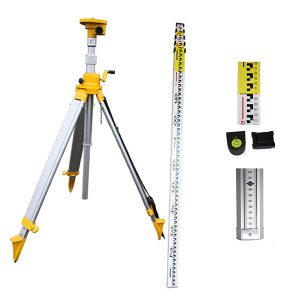
When it comes to outdoor work, it’s relatively straightforward. Throw your laser on a tripod and set it at the right height and Bob’s your uncle. If you’re earthmoving – it may be worth considering a “wind-up” or elevating tripod to mount your laser & machine receivers above the cabin of your machine. These are great for quick height adjustments anyway, so it won’t be wasted.
For indoors it’s a bit trickier – tripods don’t work too well on hard floors (can’t poke their pointy feet in too well!). They’re also often height limited – a standard tripod might get you to 1.8m high on a good day if set up in a secure spot with legs fully extended (careful not to bump it!)
So what if I need to trace a line above 1.8m high inside?
There are a few options to suit various needs, and each has their own strengths and weaknesses.
Often line lasers will come with a magnetic bracket – which is great if you have some sturdy metal at the perfect height to mount it to. These often have a hole that you can punch a screw into if needs must as well.
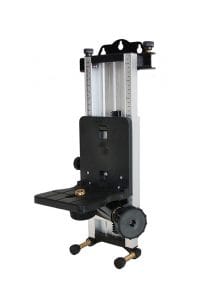
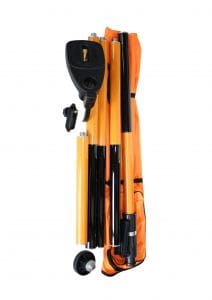
I really like a monopole setup for internal work – although these only go up to 3m high so won’t suit everywhere. The frustration with these is that they are bulky if you need to move from room to room, although they’re easy enough to dismantle and set back up.
Our newest solution to the mounting problem is a suction wall bracket – which has a built-in vacuum that sucks the bracket & laser to the wall to hold it in place. These little suckers seem pretty powerful & reliable but may not last all day – and despite their strength it might feel a bit risky to trust a $500+ laser on them, but so far they’ve been great when we’ve tested them.

Definitely consider how you’re planning on setting up your laser – because for most people, once your laser is set up in position you won’t want it moved until your work is done, and the more secure/steady your setup, the better/more accurate your results will be.
Mistake 5: Comparing laser level brightness based on colour
FACT: Green light is picked up better by the human eye than red.
FICTION: Green lasers are always brighter than red lasers.
A 5mW red laser (Class 3) is going to be brighter/more visible than a 1mW green laser (Class 2).
That’s why laser class is so important when factoring in which laser to choose. Many brands claim to sell very bright lasers, but they’re only a Class 2 laser level in reality.
Class 3/3R is the brightest laser class you can legally use in construction applications, due to both eye safety and the weapons act preventing the import and use of anything higher powered.
That’s why at RedBack Lasers we opt for Class 3 for the vast majority of our line lasers, even some of our budget options. So you get the actual best available rather than a marketing ploy. Class 2 lasers are still fine for most people’s use, but it’s chalk and cheese when these are side by side with a Class 3. (NOTE: some laser brands do lie about their laser class and underrate them – but that’s a story for another time!)
Bonus mistake: Trusting Alibaba and Temu with precision instruments
Hey – the price is appealing to us too! We get it.
You might only use your laser once in a blue moon.
But if you’re doing DIY – or worse, a trade – and relying on a laser level that is shipped from overseas without at least being checked over, let alone actually calibrated – you’re running a bit of a risk of having to potentially redo your work.
There are probably some reasonable options that you can get for a fraction of the price – but you still can’t guarantee that the laser is actually accurate when it arrives. You might do a test on one axis to check to see if they marry up okay, but if there’s a sticky bearing that you don’t notice, then the next time you move the thing it could be levelling completely different.
Also you’ll likely struggle to find a calibration/service agent willing to touch one of these models as well.
These issues can honestly apply to quite a few laser brands, not just cheap imports – it’s the same no-local-repair, can’t-be-recalibrated problem as the big tool brands in mistake 2 – but even so, you do run the risk of buying an expensive paperweight.
It won’t happen to everyone! There’ll be plenty that get a bargain I’m sure – but if you don’t want to run the risk of having to rebuy the same laser again, or having to redo your renos because you’ve got dodgy levels, then speak to us for some cost-effective options you can actually rely on.
The gear for this job
Not sure which suits you? Give us a call — we'll talk it through.
 GREEN624GM - RedBack Electronic Levelling Green Rotating Laser Level H/V with Auto Grade Match + MM Tracking Receiver
$2,399.00 inc. GST
View product →
GREEN624GM - RedBack Electronic Levelling Green Rotating Laser Level H/V with Auto Grade Match + MM Tracking Receiver
$2,399.00 inc. GST
View product →
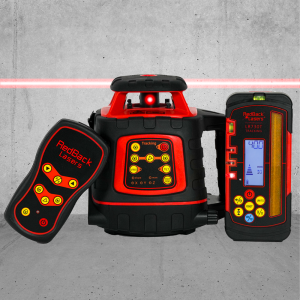 EGL624GM - Auto Grade Rotary Laser with Vertical & Pro mm Receiver
$1,999.00 inc. GST
View product →
3MIMP - Indoor Monopole 1/4 inch & 5/8 Survey Thread
$149.00 inc. GST
View product →
WB5 - Wall Mount Bracket 5/8 Survey Thread
$119.00 inc. GST
View product →
DC10 - 3 in 1 Suction Laser Mount with Dust Collector and Green Laser
$149.00 inc. GST
View product →
EGL624GM - Auto Grade Rotary Laser with Vertical & Pro mm Receiver
$1,999.00 inc. GST
View product →
3MIMP - Indoor Monopole 1/4 inch & 5/8 Survey Thread
$149.00 inc. GST
View product →
WB5 - Wall Mount Bracket 5/8 Survey Thread
$119.00 inc. GST
View product →
DC10 - 3 in 1 Suction Laser Mount with Dust Collector and Green Laser
$149.00 inc. GST
View product →
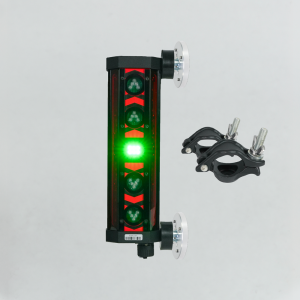 MR710 - RedBack Machine Mounted Receiver - Clamp & Magnet Mount
$1,449.00 inc. GST
View product →
MR710 - RedBack Machine Mounted Receiver - Clamp & Magnet Mount
$1,449.00 inc. GST
View product →